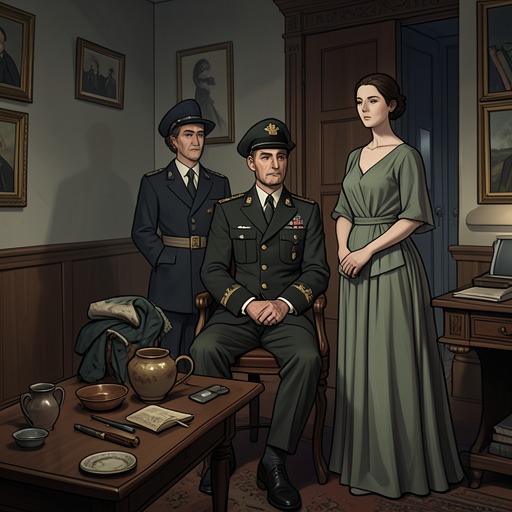
General Sternwood—Rusty Regan
The Big SleepGeneral Guy Sternwood’s relationship with Rusty Regan is defined by an attachment that outlasts the marriage between Regan and Vivian Regan. Near the end of the novel, the ailing General commissions Philip Marlowe to find Regan, but asks only for direct assurance that he is safe. His wish is not to reclaim a son-in-law who may have chosen to leave; it is to know that a man he admired is alive and able to live on his own terms.
The General’s Condition and Attachment
The General describes himself as a diminished survivor of a more extravagant life: paralyzed in both legs, able to eat little, and living with sleep that scarcely separates itself from waking. Orchids provide an excuse for the heat that sustains him. His confinement makes the remembered bond with Regan especially significant: the General has few remaining comforts, and he identifies his affection for the younger man as one of them.
When the investigation appears to be over, the General asks Marlowe whether he is still trying to solve the mystery. Marlowe says he has quit, has been warned off, and believes the job is incomplete by his own standards. The General immediately renews the commission, offering another thousand dollars to find Regan. The money serves the practical purpose of continuing the search, but the terms reveal that the General’s concern is not possession or authority.
A Search Without a Demand for Return
The General explicitly releases Regan from any obligation to come back. He says that Regan has a right to live his own life and that he does not blame him for leaving Vivian, even if the departure was abrupt. He asks only to hear from Regan directly that he is all right; if Regan needs money, the General wants him to have it. In that distinction between locating a person and claiming him, the General’s affection takes the form of care rather than control.
The request also changes the measure of a successful investigation. Marlowe need not produce Regan or disclose his whereabouts to the General if Regan does not wish it; what matters is confirmation from Regan himself. The General’s concern therefore gives the search a personal aim that is separate from the family’s need to resolve the wider mystery surrounding Regan’s disappearance.
Affection, Vulnerability, and the Family Secret
After setting out what he wants, the General admits that he may be sentimental and says he took a liking to Regan because he seemed decent. He wonders whether vanity has clouded his judgment of character, but still asks Marlowe simply to find him. The admission presents the attachment as personal and freely acknowledged, not merely an extension of Regan’s position as Vivian’s husband.
The relationship exists amid the concealment surrounding the family. Vivian later tells Marlowe that Carmen killed Regan and that she concealed the truth to spare their father the knowledge, fearing the shock would kill him. This disclosure places the General’s tenderness toward Regan beside a truth withheld from him: the man he hopes to hear from is dead, and the family’s protective silence has prevented him from knowing it. Marlowe responds by requiring Vivian to take Carmen away to a place where she can be cared for and kept from further danger, giving her three days before he reveals what happened. The General’s affection thus becomes part of the ethical stakes of the concealment, even though he never learns the truth in the supplied evidence.
The Last Commission
The General’s renewed request comes as his health is visibly failing. After speaking, he rests with his eyes closed; Marlowe observes that he is exhausted and nearly defeated by illness. The General opens his eyes again to make his final appeal, and Marlowe agrees to try. When Marlowe leaves, the General has already closed his eyes, his hands lying limp on the sheet.
The commission remains unresolved in the ending presented here: Marlowe accepts the search, but the General’s request is for reassurance from Regan, and no such reassurance arrives. Their bond is therefore marked by the gap between what the General wants to give—freedom and, if needed, money—and what he can still receive: direct news from someone he regarded as decent. It gives the investigation a quiet emotional center, while the concealed death makes that hope tragically impossible.